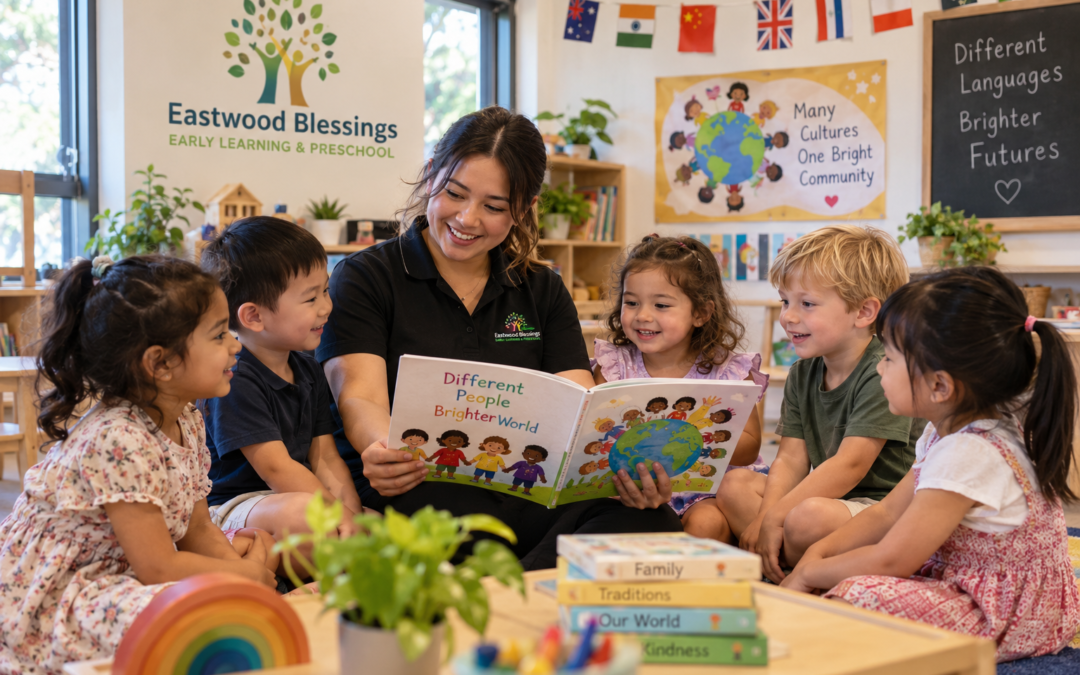
Your child’s early years are filled with moments that shape how they see people, relationships, and the world around them. A Multicultural Childcare Centre in Eastwood can give your child opportunities to hear different languages, learn about family traditions, and listen to stories that may be different from those at home.
When these experiences become part of an ordinary day, your child can begin to understand that families may eat different foods, speak different languages, celebrate different occasions, and still share many of the same feelings, hopes, and connections.
How Can Different Languages Become Part of Your Child’s Learning?
Language is more than a way to communicate what your child wants or needs.
When your child hears another language during a song, story, greeting, or conversation, your child encounters a different way of expressing an idea. Even when your child does not understand every word, the sound, rhythm, and repetition can create interest.
You might hear your child repeat a new word at home after hearing it during the day. Your child may also ask what a particular word means or wonder why someone uses a different word for the same object.
These small questions can open the door to meaningful conversations.
What Can Your Child Learn From Hearing Different Languages?
Your child can begin to understand that communication does not always sound the same.
A simple greeting in another language can lead to questions about where the word comes from. A song can introduce a new rhythm. A story can show your child that the same feeling can be expressed in different ways.
This gives your child a reason to listen carefully, ask questions, and appreciate differences without treating those differences as something unusual.
Why Do Family Traditions Matter to Your Child?
Every family has its own ways of doing things.
Your child may have a special meal during a family celebration, hear a particular story from a grandparent, or take part in a tradition that has been passed through generations.
When you share these details with your child’s learning environment, your child gets a chance to see that family experiences have value.
A family tradition does not need to be complicated. It could be a special food, a song, a greeting, a piece of clothing, a celebration or a story told before bedtime.
How Can Traditions Encourage Respect?
Your child can learn respect by listening to another family’s experience and recognising that it may be different from your own.
For example, your child might hear about a celebration involving a food they have never tried. Instead of simply asking whether it is different, your child can learn to ask where the food comes from, when it is eaten, and why it matters to that family.
That change from simply noticing a difference to asking with genuine interest is an important social skill.
How Can Family Stories Help Your Child Feel Included?
Stories can carry memories that facts alone cannot.
When your child hears about a family member, a special celebration, a move from another country, or an important family tradition, your child can begin to understand that every family has its own story.
You can also share stories from your own family. Your child might talk about a grandparent, describe a favourite family meal or explain something your family does together.
These conversations can help your child connect home experiences with the wider learning environment.
How Does Cultural Diversity Connect With Everyday Learning?
Cultural learning does not need to be treated as a separate lesson.
Your child can encounter different perspectives through books, music, conversations, creative activities, food experiences and group interactions.
That framework gives your child opportunities to connect personal experiences with relationships and the wider community.
What Might This Look Like During the Day?
Your child might listen to a story featuring a family from another part of the world, create artwork inspired by a pattern, hear a new song, or talk about a family celebration.
The important part is the conversation that follows.
Your child can ask questions, share an experience, and listen when someone else speaks. These interactions can help your child understand that different backgrounds can exist side by side.
How Can a Smaller Setting Support These Conversations?
Your child can benefit when there is enough time for individual interests to become part of the day.
Eastwood Blessings operates with a small daily group of 21 children and above-ratio staffing, allowing educators to pay close attention to individual interests and needs.
With a smaller group, your child can have more time to talk with an educator about what interests them. A question about a different language, a family tradition, or a story from home can turn into a simple conversation where your child feels heard and encouraged to keep asking questions.
How Can You Bring Your Family’s Story Into Your Child’s Day?
You do not need to prepare a formal presentation or teach your child a long list of cultural facts.
You can start with something your child already knows.
Talk about a favourite family recipe. Tell your child why a particular celebration matters to your family. Teach your child a greeting used by relatives. Look through family photographs and talk about the people, places and memories behind them.
You can also encourage your child to ask questions when another family has a different tradition.
Your child does not need to know everything about every culture. It can be as simple as listening to someone’s story, hearing a different language, asking a question about a family tradition, or learning why something is special to someone else. These everyday moments can help your child understand that families may do things differently, and that those differences are worth respecting.
FAQs
1. Why are different languages useful for my child?
Hearing different languages can give your child opportunities to listen closely, notice different sounds, and become interested in how people communicate.
2. How can family traditions support early learning?
Family traditions can give your child opportunities to talk, listen, remember, ask questions, and connect personal experiences with the wider community.
3. Can stories help my child understand cultural differences?
Yes. Stories can introduce your child to different families, places, experiences and perspectives in a way that feels accessible and engaging.
4. Does multicultural learning need to be a formal activity?
No. Your child can engage in cultural learning through everyday conversations, books, music, food experiences, celebrations, creative activities, and interactions.
5. How can I support cultural understanding at home?
You can talk openly about your family’s traditions, listen to stories from other cultures, introduce your child to different languages, and encourage respectful questions.
6. Why is inclusion important during the early years?
Your child is beginning to form ideas about relationships and community during the early years. Positive experiences with different backgrounds can help your child become comfortable with differences while learning to treat others with respect.
