Your child can learn valuable skills without spending the whole day sitting at a table, completing worksheets, or listening to instructions. Preschool programs in Eastwood can give your child opportunities to learn through cooking, movement, outdoor play, STEAM activities, sustainability projects, creative experiences, and practical everyday moments.
How Does Traditional Classroom Learning Usually Work?
Traditional classroom activities often involve sitting in one place, listening to an educator, completing worksheets, practising letters and numbers, or following the same activity from beginning to end.
These activities can support certain early skills, but your child also needs opportunities to learn by doing.
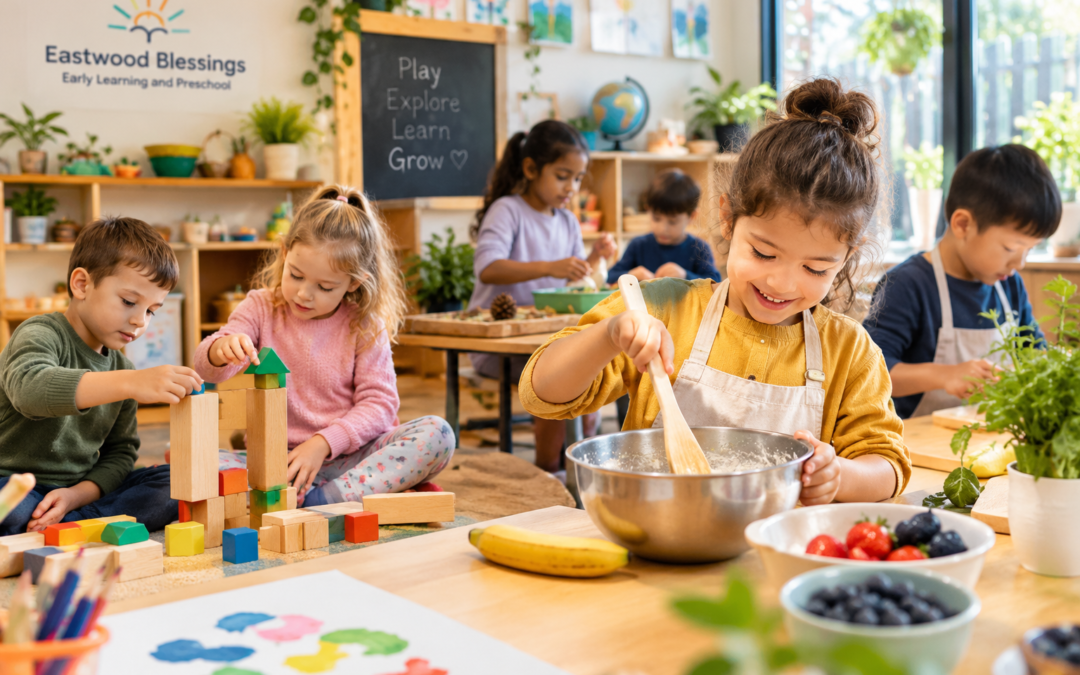
Imagine your child trying to build a bridge with blocks. The first attempt falls apart. Instead of being answered, your child can move the blocks, try a different arrangement, and see what happens.
That simple experience can involve problem-solving, concentration, coordination, decision-making, and persistence.
At Eastwood Blessings Early Learning and Preschool, learning is guided by the Early Years Learning Framework, with play-based learning, hands-on experiences, incursions, excursions, and bespoke projects forming part of the program.
How Can Learning Happen Outside a Traditional Classroom?
Your child can learn while moving, creating, talking, cooking, building, observing, and playing.
A learning experience does not always need a worksheet or a fixed lesson. Your child might count ingredients while cooking, compare objects during play, notice changes in the garden, or work out how to make a construction stand without falling.
These experiences can connect new ideas with something your child can see and feel.
This gives your child different ways to take part according to their interests and the activity happening around them.
How Can Cooking Help Your Child Learn Everyday Skills?
Your child can learn a surprising amount while preparing food.
When your child counts ingredients, compares quantities, follows steps, talks about colours, or describes different tastes, several learning skills are happening at once.
For example, asking your child to count five pieces of fruit gives your child a practical reason to use numbers. Talking about whether something is soft, crunchy, sweet, or sour gives your child opportunities to build vocabulary.
Cooking can also help your child become familiar with healthy food choices.
Cooking activities can help your child practise simple maths and language skills while learning about healthy food choices in a fun, hands-on way.
For your child, a mixing bowl can become part of the learning environment just as naturally as a book or puzzle.
What Can Your Child Learn Through STEAM?
Your child may naturally become curious when something does not work as expected.
“Why did it fall?”
“How can I make it stronger?”
“What happens if I change this?”
Questions like these can lead your child towards practical problem-solving.
STEAM activities can give your child opportunities to build, create, test ideas, make changes, and try again. At Eastwood Blessings, STEAM education focuses on creativity, problem-solving, collaboration, engagement, and motivation.
Your child does not need to find the perfect answer immediately. The process of trying something, noticing what happens, and making another attempt can be valuable in itself.
How Can Building Activities Encourage Thinking?
Give your child blocks, construction materials, or loose parts, and you may see them begin making decisions without being told exactly what to do.
Your child may decide that one block needs to be underneath another. They may notice that a structure becomes unstable when it gets too tall. They may ask for another piece or change their plan.
These small decisions give your child reasons to think, communicate, test ideas, and solve problems.
How Can Outdoor Experiences Support Learning?
Your child can learn from the environment around them.
Outside, your child may notice a new flower, watch an insect, feel different textures, observe changes in the weather, or collect natural materials for a creative activity.
A large outdoor space and sustainability activities can give your child plenty of opportunities to spend time in nature, learn about the environment, and develop a genuine appreciation for the world around them.
A simple walk outside can become an opportunity to observe, ask questions, compare, and talk about what your child sees.
How Can Dance and Yoga Make Learning More Fun?
Your child does not need to sit still to learn.
Movement gives your child opportunities to practise balance, coordination, body awareness, listening, and following instructions.
During a dance session, your child may copy a movement, remember a sequence, or move along with music. During yoga, your child can practise balance and controlled movement while having time to slow down.
Dance, yoga, and stretching give your child fun ways to stay active, build physical strength, feel more confident, and enjoy moments of calm.
These activities feel like fun and play while helping build physical strength, confidence, focus, and emotional wellbeing.
What Can Incursions and Excursions Add to Your Child’s Day?
A new experience can give your child something different to see, hear, discuss, and remember.
During an incursion, your child can take part in an experience brought into the learning environment. An excursion can give your child an opportunity to experience something beyond the usual daily surroundings.
Eastwood Blessings includes regular incursions and excursions as part of its program.
Your child can practise listening, asking questions, participating, and talking about what they experienced.
These moments can also give your child new ideas to carry into later play.
How Can Creative Activities Give Your Child More Choice?
Your child may approach a creative activity differently from another child.
One child may spend time painting lines and shapes. Another may use blocks to create a house. Another may choose puzzles or spend time looking through books.
Giving your child choices can allow their interests to guide part of the learning experience.
At Eastwood Blessings, dedicated spaces include creativity and art, construction, early puzzles, books, home play, and numeracy.
Your child can choose, experiment, change their mind, and try another activity without every experience needing the same result.
Why Can Quiet Learning Moments Matter Too?
Learning does not always need to be loud, active, or group-based.
Your child may sometimes want to sit with a book, complete a puzzle, draw quietly, or spend time in a calmer area.
These moments can give your child time to concentrate and work at their own pace.
The centre’s spaces include book and puzzle areas alongside active indoor and outdoor areas, giving your child opportunities for both energetic and quieter experiences.
Having this balance can help your child choose an activity that suits how they are feeling at that moment.
How Can Hands-On Learning Support Your Child?
Your child can often make stronger connections when an idea becomes something they can actually do.
Instead of only hearing about numbers, your child can count real ingredients. Instead of only talking about nature, your child can observe plants and outdoor surroundings. Instead of only discussing problem-solving, your child can build something and work out what to change when it does not work.
Hands-on experiences give your child a reason to use different skills together.
Eastwood Blessings provides tailored learning programs designed around each child’s individual journey, alongside practical experiences such as cooking, STEAM, movement, outdoor play, incursions, excursions, and creative activities.
How Can These Experiences Build Independence?
Your child can practise independence through small choices throughout the day.
Choosing an activity, gathering materials, helping with a simple task, putting resources away, or deciding how to approach a creative project can give your child a sense of responsibility.
You may notice your child becoming more willing to try something before asking for help.
These everyday moments can support decision-making, communication, confidence, and responsibility without making learning feel like a formal lesson.
How Can Learning Beyond the Classroom Support School Readiness?
School readiness involves more than knowing letters and numbers.
Your child can also benefit from practising how to listen, communicate, make choices, participate in group experiences, manage simple tasks, and keep trying when something feels difficult.
Eastwood Blessings identifies confidence and independence as important parts of school readiness.
When your child takes part in cooking, construction, creative activities, movement, outdoor play, and group experiences, your child can practise many of these skills naturally.
FAQs
1. Can your child learn without traditional classroom activities?
Yes. Your child can learn through cooking, construction, outdoor experiences, STEAM activities, movement, creative play, sustainability activities, incursions, excursions, and everyday routines.
2. What are examples of hands-on learning for your child?
Your child can count ingredients while cooking, build with blocks, work through puzzles, create artwork, observe nature, or take part in practical STEAM activities.
3. How can STEAM activities support your child?
STEAM activities can give your child opportunities to create, test ideas, solve problems, collaborate, make changes, and try different approaches.
4. Can outdoor play support early learning?
Yes. Outdoor play can give your child opportunities to move, observe nature, interact with the environment, communicate with others, and take part in physical activities.
5. Can cooking help your child develop early maths skills?
Yes. Counting ingredients, comparing quantities, measuring, and following sequences can give your child practical opportunities to use early mathematical concepts.
