
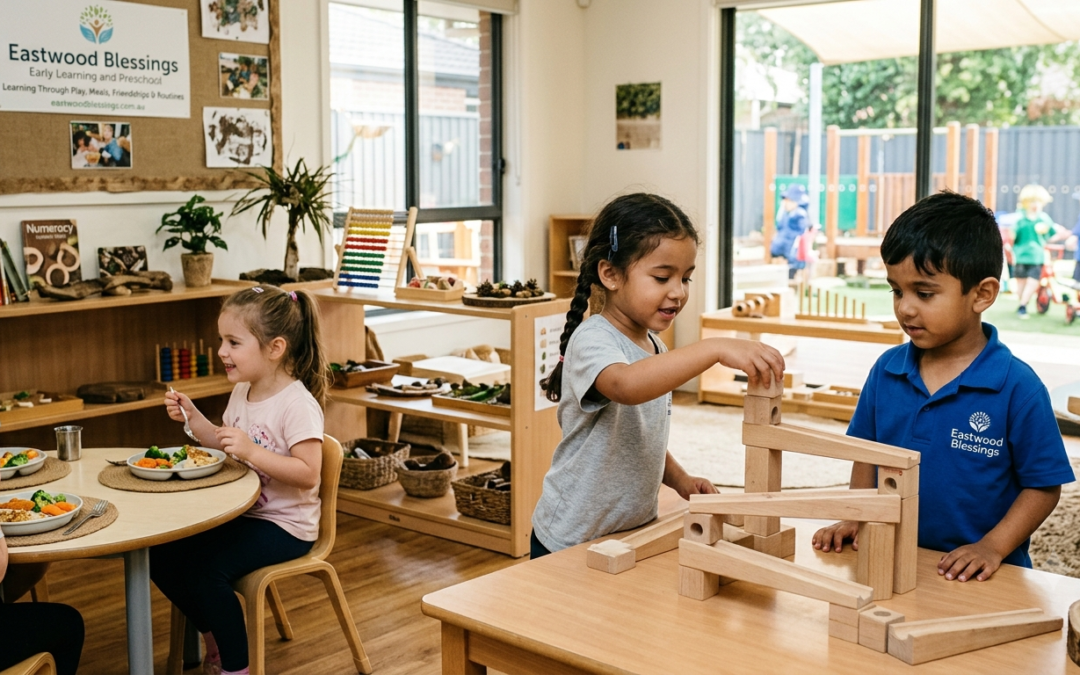
Your child can learn from far more than planned activities during a day of care. Long Day Care Programs in Eastwood can turn play, meals, friendships, and familiar routines into small learning moments that help your child practise useful skills naturally.
At Eastwood Blessings Early Learning and Preschool, your child can take part in play-based learning, cooking, movement, STEAM experiences, outdoor play, and everyday routines. These experiences can give your child different ways to communicate, make choices, solve problems, and become more independent.
How Can Play Turn Ordinary Moments Into Learning?
Play gives your child a chance to make decisions instead of simply following instructions.
Imagine your child building a tower with blocks. Your child places one block on another, watches the tower fall, and then tries a different arrangement. That simple moment can involve balance, problem-solving, planning, patience, and persistence.
Your child may also move between drawing, puzzles, books, construction, home play, or creative activities. Each choice can give your child a different way to practise skills while enjoying the activity.
The learning spaces at Eastwood Blessings include construction, creativity and art, numeracy, books, puzzles, home play, and nature-based areas.
What Can Your Child Learn When Play Does Not Go to Plan?
Not every attempt will work the first time.
Your child may build something that falls apart, struggle to fit a puzzle piece, or change the rules of a pretend game. Instead of seeing these moments as failures, your child can practise trying another approach.
That is where ordinary play can become meaningful learning.
How Can Meals Give Your Child More Than Something to Eat?
Mealtimes can give your child opportunities to practise everyday skills.
Your child may talk with others, wait for a turn, use utensils, ask for help, make choices, and become familiar with different foods. These actions may seem small, but they can help your child become more comfortable with daily responsibilities.
How Can Cooking Turn Food Into a Learning Experience?
Cooking can make learning feel practical.
Your child might count ingredients, compare quantities, talk about colours and textures, follow steps, or learn new words while preparing food. A simple cooking activity can therefore bring maths, language, sequencing, and healthy eating into one experience.
The centre’s cooking classes specifically support basic maths and language skills while introducing healthy eating habits.
Why Can Friendships Become Everyday Learning Moments?
Your child does not need a formal lesson to practise social skills.
When your child joins a game, shares a toy, waits for a turn, or talks with another child, your child is learning how to interact with other people.
Your child might want the same toy as a friend. Instead of immediately taking it, your child can practise asking, waiting, negotiating, or choosing something else. These moments can help your child understand that other people have ideas and needs too.
What Can Your Child Learn From Playing With Others?
Friendships can give your child reasons to listen, speak, cooperate, and respond.
A pretend game may require your child to agree on roles. Building something together may require your child to share materials. A group activity may require your child to wait while someone else has a turn.
These everyday interactions can help your child practise communication and cooperation in situations that feel real.
How Can Daily Routines Teach Your Child to Do More Independently?
Your child’s daily routine can contain many small opportunities to practise independence.
Putting belongings away, washing hands, getting ready for meals, choosing an activity, preparing for outdoor play, and tidying up can all involve simple decisions and actions.
Your child may initially need help with these tasks. With regular practice, your child can begin to remember what comes next and take greater responsibility.
That can make a familiar routine feel less like a set of instructions and more like an opportunity for your child to say, “I can do this.”
How Do Play, Meals, Friendships, and Routines Work Together?
The most meaningful learning moments do not always happen separately.
Your child may play a pretend cooking game, later take part in a real cooking activity, talk about the food with friends during lunch, and then help tidy the area afterwards.
One experience can lead naturally into another.
The Early Years Learning Framework guides learning around identity, community, wellbeing, learning, and communication, which gives everyday experiences a broader purpose.
At Eastwood Blessings Early Learning and Preschool, tailored learning programs are designed around your child’s individual journey, while the centre also provides opportunities such as STEAM education, yoga, cooking, incursions, excursions, and outdoor play.
Why Do These Small Moments Matter to Your Child?
Your child spends a large part of the day experiencing ordinary moments.
A conversation with a friend can practise language. A meal can practise independence. A block tower can practise problem-solving. A familiar routine can help your child understand responsibility.
You may not always notice these lessons when they happen, but they can become part of how your child learns to communicate, make choices, manage simple challenges, and participate with others.
That is what makes everyday experiences valuable: your child does not need every moment to look like a lesson for learning to happen.
FAQs
1. Can play really become a learning experience for your child?
Yes. Play can give your child opportunities to practise creativity, communication, decision-making, problem-solving, cooperation, and persistence.
2. How can mealtimes support your child’s learning?
Mealtimes can help your child practise independence, communication, social behaviour, and familiarity with different foods.
3. Why are friendships important during long day care?
Friendships can give your child regular opportunities to practise sharing, listening, taking turns, communicating, cooperating, and responding to other people.
4. How can daily routines support independence?
Simple tasks such as washing hands, tidying up, preparing for meals, and getting ready for outdoor play can help your child practise doing things with less assistance.
5. Can cooking activities support early learning?
Yes. Cooking can give your child practical opportunities to practise counting, quantities, language, sequencing, and healthy eating habits.
6. How does outdoor play become a learning opportunity?
Outdoor play can give your child opportunities to move, create, interact with friends, use imagination, and take part in hands-on experiences.
7. What should you look for in a long day care program?
Look for opportunities for your child to learn through play, relationships, routines, meals, movement, creativity, and hands-on experiences rather than focusing only on formal activities.
