
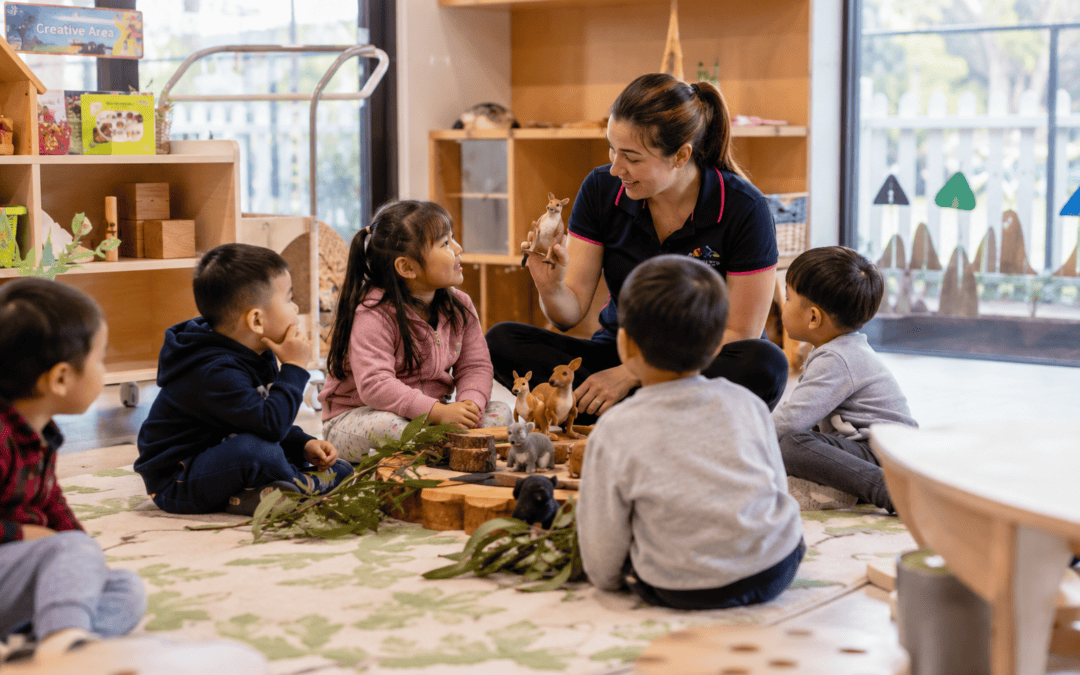
Your child asks questions all day because that is how they work out how the world behaves, and the answers they get decide whether they keep asking. An early learning center encourages curiosity through three practical things: the way the room is set up, the number of children each educator is responsible for, and what it puts in front of your child each week.
Seven Ways a Center Keeps Curiosity Going
1. Separate learning areas your child can choose between
The room is set out as a construction area, a home corner, a numeracy corner, a book corner, an art and creativity space, and a puzzle area. Choice is the point. Your child follows what already interests them instead of joining whatever the group happens to be doing.
2. Small daily numbers
A 21-place center per day puts fewer children between your child and an educator. Interest is easy to miss in a crowded room and easy to catch in a small one, and that is true whether your child announces what they are thinking or keeps it to themselves.
3. Educators fostered above ratio
Above-ratio staffing buys an educator time to sit with one child’s question rather than keep the whole group moving. That is the difference between a question being answered and a question being followed.
4. A learning plan built around your child
A tailored learning program starts from what your child is already doing rather than from a set curriculum. Three days spent lining up toy animals by size turns into a measuring activity on the fourth.
5. Questions turned into projects
Play-based learning and bespoke projects run on your child’s own questions. The Early Years Learning Framework sits underneath, with outcomes covering identity, community, wellbeing, learning and communication, but the working version is simpler: the question becomes the week’s project.
6. Hands-on sessions on the weekly program
Cooking classes bring measuring, sequencing and unfamiliar words, with something edible at the end. STEAM sessions ask your child to build something, watch it fail, and work out why. The sustainability program hands them a seedling and a question that cannot be answered the same day.
7. Incursions, excursions and a large outdoor space.
Incursions and excursions bring faces, tools and places into the week that your child would not otherwise meet. A big outdoor area supplies the unplanned questions, and dance and yoga sessions add another kind of noticing, the sort where your child works out what their own body can do.
The Signs You Will Notice at Home
The second is vocabulary. Words arrive that you never taught, usually attached to a cooking session or a garden bed, and your child uses them correctly because they were learned while doing something.
The third is confidence in unfamiliar tasks. A child whose questions are treated as useful will try a new activity without first checking whether they are allowed to. That habit carries into a classroom far more reliably than a pre-taught alphabet, which is the part of school readiness worth paying attention to.
Strong family partnerships make all three easier to track, since educators who tell you what your child worked on give you something specific to pick up at the dinner table.
Frequently Asked Questions
1. How do you know a center is building on your child’s interests?
Look at the program on display and the observations educators share with you. Both should name your child and refer to something they actually did that week, rather than describing the group as a whole.
2. Does curiosity-led learning still cover school readiness?
Yes. The framework sets the outcomes, and play-based activities are how a center reaches them. Your child gets the letters and numbers, plus the habit of asking.
3. What if your child hangs back rather than asking questions?
Quiet children are often the most observant. Separate learning areas help, since your child can settle somewhere alone rather than joining whatever the group is doing.
4. Why does the educator-to-child ratio matter?
Interest is easy to miss in a crowded room. Fewer children per educator means someone notices a pattern in your child’s play and builds on it the next day.
5. Can you see the learning spaces before enrolling?
Yes. A virtual tour shows the classrooms, play spaces, and outdoor areas from home, and joining the waitlist costs nothing while you decide.
What Should You Look For When You Visit?
Watch one child for five minutes instead of scanning the whole room. Notice whether they choose where to go, whether an educator follows them there, and whether anything interrupts them before they are finished.
That one observation tells you more than any list of features. A center can have every learning area, every program, and every staffing ratio on paper and still run a day when children are moved along on a timetable. Curiosity lives in the room where nobody is being hurried, and you can see that within minutes of walking in. Eastwood Blessings Early Learning and Preschool sets up its rooms, its staffing, and its weekly program around that, and a virtual tour or a walk-through will show you how it runs on an ordinary day. Book your visit for mid-morning rather than close to nap time. That is the stretch of the day when you can see whether the children are following their own questions or following the clock.
