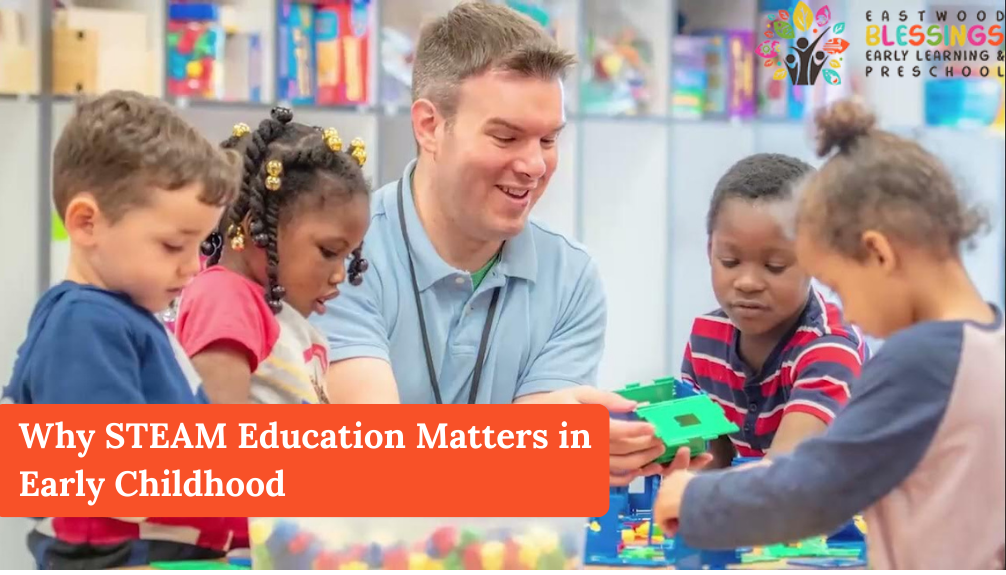

Early childhood is the perfect time to introduce children to STEAM: Science, Technology, Engineering, Arts, and Math. At Eastwood Blessings, STEAM education for preschoolers lays the foundation for lifelong learning, fostering creativity, critical thinking, and problem-solving skills. Integrating hands-on learning and play-based approaches ensures children develop holistically and are school-ready.
1. What is STEAM Education?
STEAM combines Science, Technology, Engineering, Arts, and Math to create a balanced, creative, and analytical approach to learning. At Eastwood Blessings, children explore concepts through curiosity-driven experiments, games, and artistic projects.
Key Benefits:
- Encourages logical and analytical thinking
- Boosts creativity and innovation
- Develops collaboration and teamwork
2. Benefits of STEAM Education for Preschoolers
Implementing STEAM programs for preschoolers at our programs strengthens cognitive and social development.
Benefits Include:
- Cognitive Growth: Enhances memory, reasoning, and early problem-solving
- Social Skills: Encourages teamwork, sharing, and empathy
- Creativity & Innovation: Encourages thinking outside the box
3. Fun Science Activities for Preschoolers
Practical experiments spark curiosity and hands-on learning.
Activities:
- Water play experiments
- Magnet exploration
- Growing plants or mini-gardening projects
4. Developing Social Skills in Early Childhood
Social skills are as crucial as cognitive skills. At Eastwood Blessings, children participate in interactive sessions that nurture collaboration and communication.
Highlights:
- Play-Based Interaction: Learning to take turns, share, and communicate
- Social Development in Early Childhood: Builds empathy and cooperation
- Social Skills Training for Children in Eastwood: Structured group activities for confidence
5. School Readiness and Preschool Prep
Preparing children for school goes beyond academics. STEAM education paired with play-based learning activities ensures children are ready academically, socially, and emotionally.
Tips for Preschool Readiness:
- Develop problem-solving through puzzles and creative projects
- Encourage early literacy and numeracy skills
- Promote independence and responsibility
6. Importance of Early Childhood Cognitive Development
STEAM activities support brain growth and critical thinking. By combining exploration, experimentation, and play, children enhance early childhood cognitive development naturally.
Key Points:
- Stimulates curiosity and inquiry
- Builds memory and attention span
- Encourages logical thinking and experimentation
7. Integrating Play-Based Learning
At Eastwood Blessings, play-based learning activities form the core of every program. This approach blends fun with skill-building.
Benefits:
- Encourages creativity and self-expression
- Enhances developing social skills for children
- Strengthens engagement and motivation to learn
8. What is EYLF and Why It Matters
The Early Years Learning Framework (EYLF) guides high-quality early childhood education in Australia. At Eastwood Blessings, we align programs with the EYLF principles to ensure holistic growth.
Key Takeaways:
- Promotes play-based learning and exploration
- Supports early childhood social development in Eastwood
- Builds foundations for lifelong learning and school readiness
Conclusion
Early exposure to STEAM education at Eastwood Blessings nurtures problem-solving skills, cognitive growth, and social development. By combining play-based learning activities, structured social skills training, and a focus on school readiness in Eastwood, children are prepared for future success, both academically and socially.
Call to Action: Encourage parents to engage children in STEAM activities and enroll them in preschool Eastwood, NSW, programs for a strong start in early learning.
FAQ
Q1: What is STEAM education for preschoolers?
STEAM education integrates Science, Technology, Engineering, Arts, and Math to promote creativity, problem-solving, and social skills in early childhood.
Q2: What is EYLF?
EYLF (Early Years Learning Framework) guides early childhood education programs in Australia, focusing on play-based learning and holistic development.
Q3: How can I develop social skills in children?
Engage them in group activities, interactive play, and structured programs like social skills training for children in Eastwood.
Q4: What are play-based learning activities?
Fun, hands-on activities that encourage exploration, creativity, and learning through play, enhancing cognitive and social growth.
Q5: How do STEAM activities support school readiness?
They develop critical thinking, problem-solving, collaboration, and cognitive skills, preparing children for structured learning environments.