

Most parents ask the same question at some point:
“If my child is just playing all day, are they actually learning?”
It’s a fair concern. Traditional education conditioned us to believe learning must look structured, quiet, and worksheet-driven. But in early childhood, that assumption is wrong.
High-quality play-based learning childcare environments are not casual babysitting spaces. They are intentionally designed ecosystems where children build cognitive, social, emotional, and physical skills through structured, guided play.
This article breaks down exactly:
- What is play-based learning is
- Why it works
- The real benefits of play-based learning
- How it supports early childhood development
- What to look for in a quality childcare centre
If you want your child to thrive, not just be occupied, keep reading.
What Is Play-Based Learning?
The definition of play-based learning is simple:
A child-centred educational approach where learning happens through exploration, creativity, and meaningful play experiences, guided intentionally by educators.
It is not random free play. It is not unstructured chaos.
It combines:
- Child-led curiosity
- Educator-guided learning moments
- Purposeful activity design
- Developmental milestone alignment
In other words, children learn because they’re engaged, not because they’re forced.
How Play-Based Learning Works in Childcare
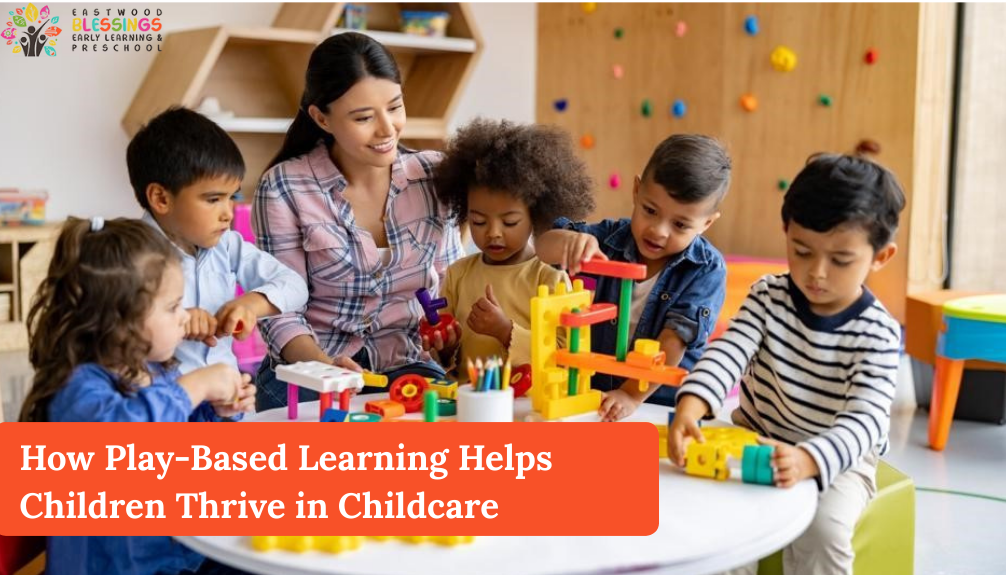
In a quality play-based learning childcare setting, activities are carefully planned around developmental milestones. Educators create structured environments that encourage collaboration, creativity, and independent thinking.
In a quality early learning childcare setting, educators:
- Observe children’s interests
- Design activities that build specific skills
- Ask open-ended questions
- Extend learning through conversation and interaction
- Encourage problem-solving
For example:
A child building a tower with blocks is not just stacking. They are learning:
- Balance and gravity
- Spatial awareness
- Early engineering concepts
- Patience and persistence
- Cause and effect
When an educator asks, What do you think will happen if we add another block? learning deepens.
That’s intentional teaching, disguised as play.
The Science Behind Play-Based Learning
Neuroscience research confirms that active engagement strengthens neural pathways in early childhood. As children move through different child development stages, play helps solidify problem-solving and emotional regulation skills. This scientific foundation is why the EYLF framework prioritises learning through play in early education settings.
Early childhood (0–5 years) is the most critical period of brain development.
Neuroscience shows:
- 90% of brain growth happens before age 5
- Neural connections form through interaction and experience
- Active engagement strengthens memory and retention
Play stimulates:
- Executive functioning
- Language development
- Emotional regulation
- Critical thinking
- Creativity
When children actively manipulate materials, negotiate with peers, and solve small problems, their brains build stronger pathways than passive instruction ever could.
Play isn’t a break from learning.
It is learning.
Benefits of Play-Based Learning
The benefits of play-based learning extend beyond academics. Children gain confidence, resilience, and independence while strengthening communication abilities. In structured environments, they learn cooperation and empathy, which are essential for social skills for children in Eastwood and beyond.
Let’s break this down clearly. The benefits of play-based learning are not abstract. They’re measurable and observable.
1. Boosts Cognitive Development
Play-based environments support:
- Early literacy skills
- Numeracy understanding
- Pattern recognition
- Logical reasoning
- Memory retention
For example:
Sorting coloured blocks builds classification skills. Pretend grocery stores introduce counting and currency concepts. Storytelling develops vocabulary and narrative sequencing.
These are foundational academic skills, built naturally.
2. Strengthens Social and Emotional Skills
Social-emotional development is often overlooked in traditional models. That’s a mistake.
Through guided play, children learn:
- Empathy
- Cooperation
- Conflict resolution
- Emotional regulation
- Turn-taking
When two children want the same toy, educators guide negotiation rather than imposing authority. This builds resilience and communication skills.
These are life skills, not just school skills.
3. Encourages Physical Development
High-quality early childhood development activities include movement.
Play supports:
- Fine motor skills (cutting, drawing, threading beads)
- Gross motor skills (running, climbing, balancing)
- Coordination
- Strength and flexibility
Outdoor exploration is especially powerful. Climbing structures builds confidence and calculated risk assessment, something children cannot learn from screens or worksheets.
4. Builds Independence and Confidence
Play-based environments allow children to:
- Make choices
- Test ideas
- Fail safely
- Try again
When children initiate play, they develop autonomy.
That confidence carries into:
- School readiness
- Peer relationships
- Academic challenges
Children who are trusted to explore tend to become independent learners.
Play-Based Learning vs Traditional Teaching
Traditional early education often prioritises memorisation over understanding. In contrast, play-based learning encourages children to discover concepts through experience.
This method aligns with the EYLF framework, which emphasises holistic growth across all learning domains. By focusing on exploration rather than pressure, children progress naturally through child development stages while strengthening social skills and cognitive capacity.
Let’s be direct.
Traditional early education often relies on:
- Worksheets
- Rote memorisation
- Teacher-led instruction
- Passive listening
Play-based learning focuses on:
- Active engagement
- Hands-on exploration
- Child-led curiosity
- Guided discovery
Here’s the difference clearly:
| Traditional Model | Play-Based Learning Childcare |
| The teacher directs learning | Child explores with guidance |
| Focus on the right answers | Focus on the thinking process |
| Limited movement | Physical interaction encouraged |
| Passive engagement | Active participation |
Young children are not mini adults. They are wired to learn through experience, not lectures.
Examples of Early Childhood Development Activities
Effective early childhood development activities include sensory play, role play, outdoor exploration, and creative expression. Each activity targets specific milestones within early childhood cognitive development and social growth.
These structured experiences help in developing social skills for children while enhancing curiosity and engagement. When delivered intentionally, they build strong foundations for School Readiness in Eastwood.
If you’re wondering what this looks like in practice, here are real examples.
Sensory Play
Activities:
- Sand and water tables
- Playdough
- Textured materials
Skills developed:
- Sensory integration
- Fine motor strength
- Language expansion
Dramatic Role Play
Activities:
- Pretend kitchens
- Doctor stations
- Construction zones
Skills developed:
- Social negotiation
- Vocabulary
- Imagination
- Problem-solving
Outdoor Exploration
Activities:
- Nature walks
- Obstacle courses
- Gardening
Skills developed:
- Gross motor coordination
- Environmental awareness
- Risk assessment
Is Play-Based Learning Effective for School Readiness?
Yes, when aligned with structured learning outcomes. Play-based programs designed under the EYLF framework intentionally prepare children for formal schooling. They strengthen early childhood cognitive development, emotional regulation, and social confidence.
Families prioritising School Readiness in Eastwood benefit from environments that balance exploration with intentional teaching.
Children from strong play-based learning childcare environments often enter school with:
- Strong language skills
- Better emotional regulation
- Confidence in group settings
- Curiosity and problem-solving ability
Academic skills can be taught quickly.
But:
- Emotional resilience
- Social confidence
- Self-regulation
Those take years to build, and play-based learning builds them early.
How to Choose a Quality Play-Based Learning Childcare Centre
Look for centres that clearly reference the EYLF framework in their curriculum planning. Educators should understand child development stages and adapt activities accordingly.
Strong programs actively focus on social skills for children in Eastwood while also supporting academic foundations. Transparency, structured environments, and consistent communication are indicators of quality.
Here’s what to look for:
1. Educators Who Engage, Not Supervise
Are teachers asking questions?
Are they extending conversations?
Or are they just watching children play?
2. Evidence of Intentional Learning
Look for:
- Documented learning outcomes
- Activity planning aligned with developmental stages
- Observations shared with parents
3. Balanced Structure
Pure free play without guidance is incomplete.
You want:
- Structured routines
- Guided learning moments
- Child-led exploration
4. Environment Design
A strong play-based childcare environment includes:
- Clearly defined learning zones
- Open-ended materials
- Outdoor space
- Calm, organised spaces
If the environment looks chaotic or overly rigid, that’s a red flag.
Why Play-Based Learning Helps Children Truly Thrive
Children thrive when learning feels meaningful and engaging. Play-based programs nurture curiosity, independence, and resilience across all child development stages.
By supporting early childhood cognitive development and developing social skills for children, this approach creates confident learners. For families seeking long-term School Readiness in Eastwood, play-based learning is not optional; it’s strategic.
Thriving is more than academic achievement.
A thriving child is:
- Curious
- Confident
- Socially capable
- Emotionally regulated
- Physically active
- Problem-solving oriented
Play-based learning supports holistic development, not just test readiness.
Frequently Asked Questions
What is a play-based learning approach?
It is a child-centred teaching method where learning happens through guided play, exploration, and real-world experiences.
What are the benefits of play-based learning?
It improves cognitive development, emotional regulation, social skills, creativity, independence, and school readiness.
Is play-based learning just free play?
No. It includes intentional teaching strategies where educators guide learning within play experiences.
How does play-based learning support early childhood development?
It strengthens neural connections, builds executive functioning skills, enhances language development, and supports motor growth.
Does play-based learning prepare children for school?
Yes. Children develop critical thinking, communication skills, emotional resilience, and foundational academic concepts.
Final Thoughts
If you still think play is just play, you’re underestimating how children’s brains work.
Eastwood Blessings‘ environment doesn’t lower standards; it raises them by aligning education with how young children actually learn. The goal isn’t to push academics too early. The goal is to build confident, capable, curious learners who are prepared not just for school, but for life.If you’re evaluating childcare options, don’t just ask what your child will be taught. Ask how they’ll be encouraged to explore, think, question, and grow. That’s the difference between supervision and education.