
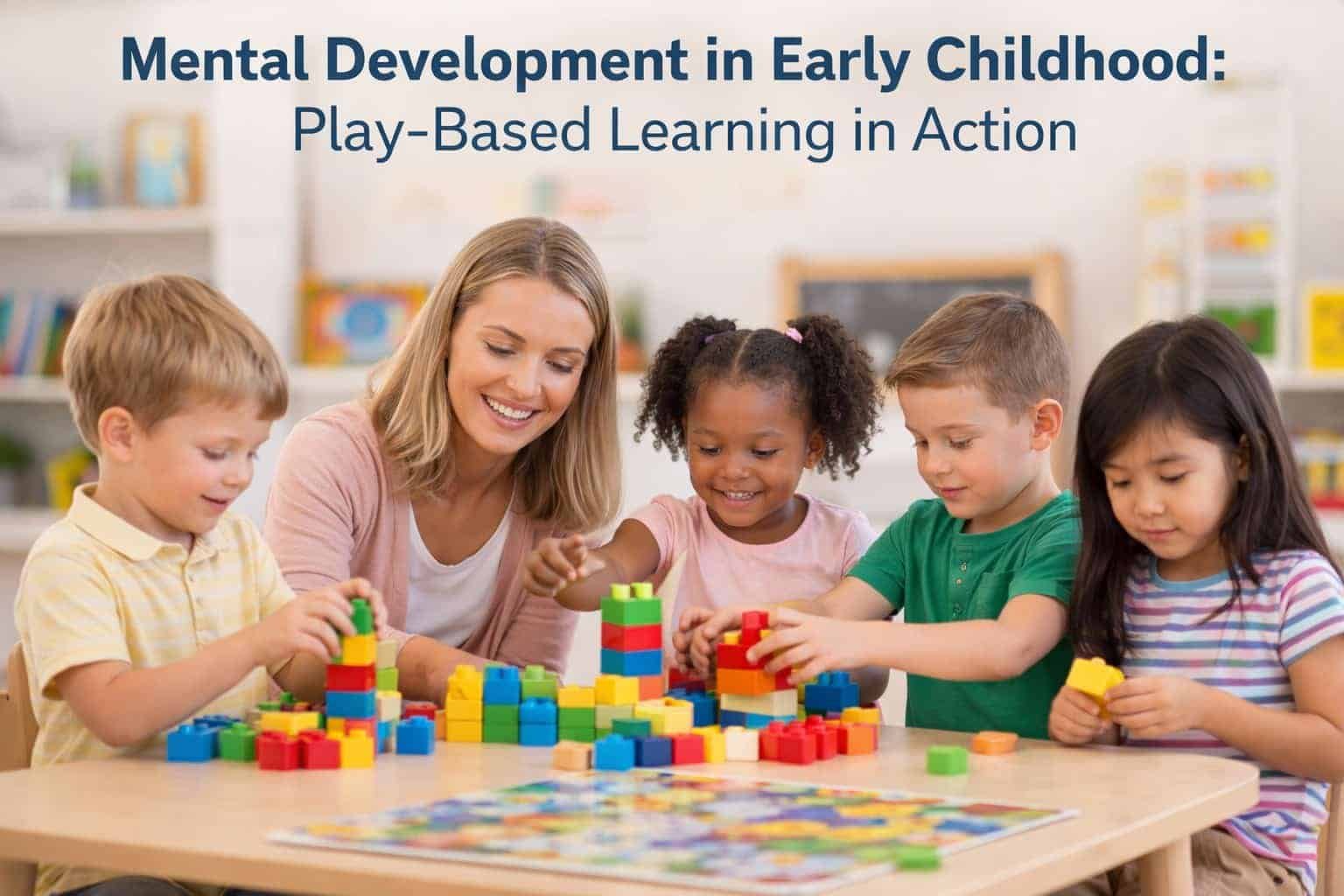

The early years of a child’s life are a period of rapid mental development in early childhood. During this time, children develop cognitive abilities, problem-solving skills, memory, and critical thinking. Parents and educators play a vital role in supporting this growth by providing structured programs, interactive play, and stimulating learning experiences.
Early childhood development programs provide an ideal environment for this growth, combining education, play, and social interaction to enhance children’s brain development in early childhood. In this guide, we’ll explore practical activities, strategies, and insights that parents can use to foster mental development effectively.
Engaging children in fun and purposeful activities strengthens their thinking skills, memory, and creativity.
Understanding Mental Development in Early Childhood
Mental development in early childhood refers to the growth of a child’s cognitive abilities, learning capacity, and problem-solving skills. This growth is closely linked with brain development in early childhood. The first five years are crucial for establishing neural pathways that influence lifelong learning.
Stages of Cognitive Growth
| Age | Cognitive Skill | Example Activity |
| 0–1 year | Sensory exploration | Touch, taste, textures |
| 1–2 years | Object recognition | Shape sorters, stacking blocks |
| 2–3 years | Problem solving | Simple puzzles, matching games |
| 3–4 years | Memory & reasoning | Story sequencing, role play |
| 4–5 years | Critical thinking | Sorting by color/size, basic counting |
Structured learning programs help children progress through these stages smoothly while building confidence and curiosity.
Activities to Boost Mental Development
Engaging children in stimulating activities encourages early childhood cognitive development. Parents and educators can implement simple, daily activities that make learning fun.
Effective Activities
- Puzzles and brain games: Improve problem-solving and memory.
- Storytelling and memory exercises: Enhance comprehension and recall.
- Building blocks and pattern recognition: Develop spatial reasoning.
- Sorting, counting, and sequencing: Strengthen logic and attention to detail.
- Creative problem-solving games: Encourage imagination and experimentation.
Pro Tip:
Even 15–20 minutes of focused, playful learning daily can significantly impact a child’s mental growth.
The Role of Play in Cognitive Growth
Play is essential for stimulating the mind. Programs that emphasize types of play in early childhood development ensure children learn while having fun.
Types of Play
- Free play – Encourages creativity and independent thinking
- Guided play – Builds problem-solving skills under adult guidance
- Physical play – Supports brain-motor coordination
- Social play – Enhances reasoning, empathy, and teamwork
For structured play ideas, see early childhood development programs.
Play-based learning is one of the most effective ways to promote mental development in young children.
Supporting Problem-Solving and Critical Thinking
Developing problem-solving skills in children is crucial for mental growth. Parents can incorporate activities that challenge thinking and encourage experimentation.
Strategies
- Ask open-ended questions: “What happens if…?”
- Introduce simple challenges: building bridges with blocks
- Encourage trial-and-error and learning from mistakes
- Promote group problem-solving to foster social-emotional development
Example Activity: Provide children with a box of random blocks and ask them to create a bridge or tower, guiding them to explore different solutions.
At-Home Strategies for Parents
Parents can play a direct role in enhancing mental growth outside formal programs. Here are easy-to-implement strategies:
- Read together daily: Storytelling improves memory, comprehension, and language skills.
- Encourage imaginative play: Role-playing builds creativity and reasoning.
- Use hands-on arts and crafts: Develops fine motor skills and problem-solving abilities.
- Outdoor exploration: Nature walks and sensory play stimulate curiosity and observation.
- Interactive learning apps: Use digital tools mindfully to support cognitive learning.
Consistency is key. Short, daily sessions are more effective than infrequent intensive activities.
Benefits of Mental Development in Early Childhood
Supporting mental growth early provides long-term benefits:
- Improved attention, memory, and problem-solving
- Stronger school readiness and academic foundation
- Enhanced creativity and imagination
- Positive impact on social-emotional development
Comparison Table: Activities vs. Skills Developed
| Activity Type | Mental Skill Developed | Example |
| Puzzles | Problem-solving | Shape sorter |
| Storytelling | Memory & comprehension | Bedtime stories |
| Block building | Spatial reasoning | Stacking blocks |
| Outdoor play | Observation & curiosity | Nature walks |
A combination of guided and free play, along with structured learning, provides the best results.
Conclusion
Mental development in early childhood is foundational for a child’s overall growth. By incorporating brain-stimulating activities, problem-solving exercises, and play, parents can enhance cognitive skills effectively.
High-quality early childhood development programs complement at-home strategies by providing structured learning environments that support both cognitive and social-emotional development.
Start small, stay consistent, and make learning fun. Every playful interaction can significantly impact a child’s mental growth.
FAQs
Q1: What is mental development in early childhood?
A1: It refers to growth in cognitive abilities, problem-solving, memory, reasoning, and attention.
Q2: Can parents help with mental development at home?
A2: Yes! Reading, puzzles, creative play, and outdoor exploration are highly effective.
Q3: How does play influence brain development?
A3: Play stimulates neural pathways, enhancing memory, attention, and reasoning.
Q4: What types of play are best for cognitive growth?
A4: Free play, guided play, physical play, and social play all contribute to mental development.
Q5: How do mental development and social-emotional skills connect?
A5: Problem-solving in groups and cooperative play improve both cognitive and social abilities.