
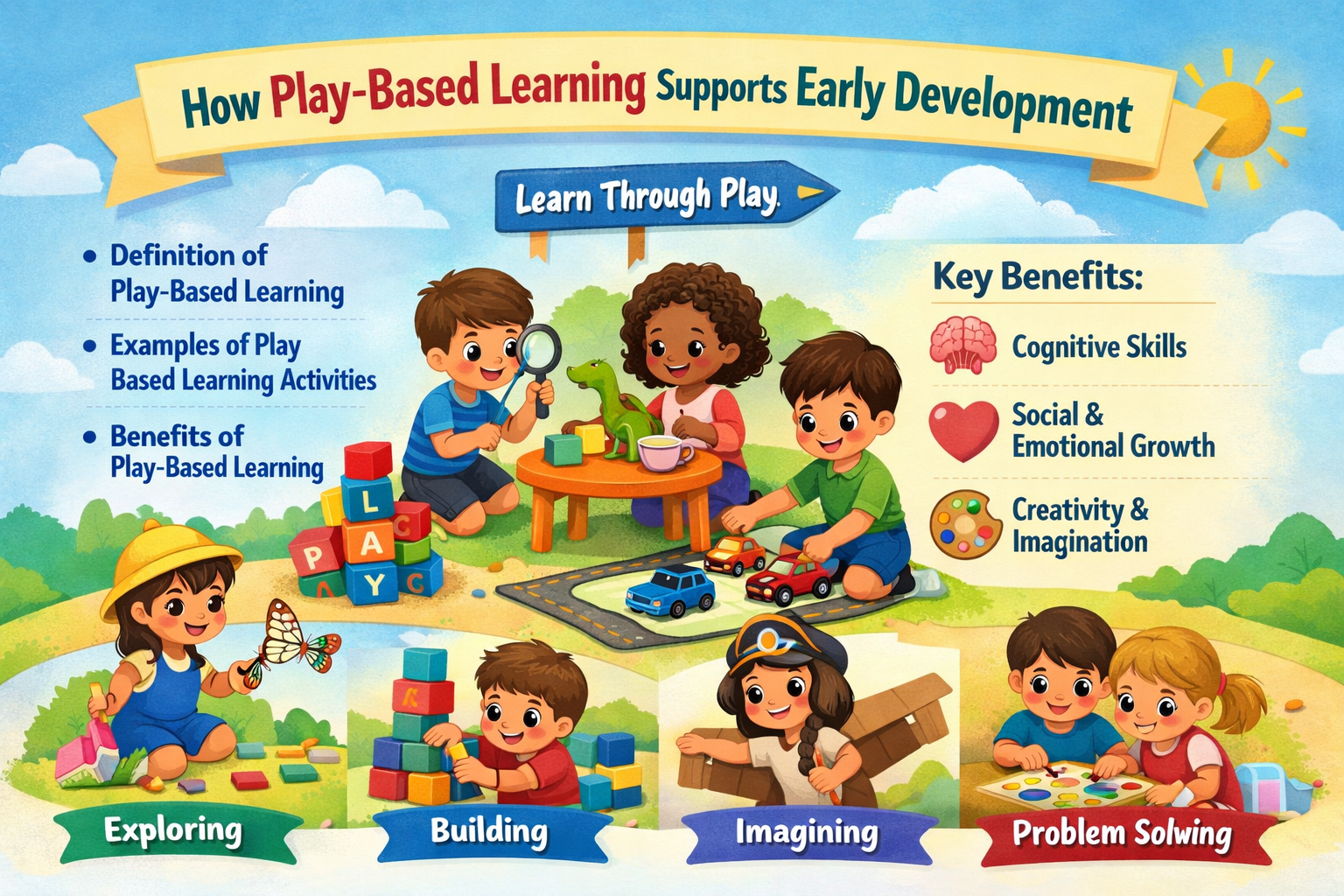

Play is not a break from learning; it is how young children learn best. In the early years, children build the foundations for thinking, communication, emotional regulation, and social skills at a rapid pace. Educational approaches that align with this natural development create stronger, longer-lasting outcomes.
Play-based learning is one such approach. Widely recognised across Australia, it supports early development by allowing children to explore concepts through meaningful, guided play experiences rather than rigid instruction.
This article explains what a play-based learning approach is, its definition, real-world examples, and the long-term benefits of play-based learning in early childhood.
What Is Play-Based Learning?
The definition of play-based learning refers to an educational approach where children learn through play experiences that are intentionally designed and supported by educators to achieve developmental outcomes.
In simple terms, play-based learning means:
- Children learn by actively exploring and experimenting
- Play is purposeful, not random
- Educators guide learning through observation and interaction
If you are still wondering what play-based learning is, it is not unstructured free time. It is a planned approach where learning goals are embedded within play.
To understand how this approach is applied in practice, you can explore our detailed overview of play-based learning where fun sparks growth.
Play-Based Learning vs Traditional Learning
Traditional education often relies on direct instruction, worksheets, and repetition. Play-based learning, on the other hand, recognises that young children learn best through experience and engagement.
| Area | Play-Based Learning | Traditional Learning |
| Learning style | Child-led with guidance | Teacher-led |
| Engagement | High | Often passive |
| Skill development | Holistic | Mostly academic |
| Motivation | Intrinsic | External rewards |
| Flexibility | High | Low |
This difference explains why play-based learning is increasingly prioritised in early childhood education across Australia.
Play-Based Learning in Early Childhood
Play-based learning in early childhood is particularly effective because it aligns with how young children naturally process information. At this stage, children learn best through movement, interaction, and hands-on experiences rather than abstract instruction.
Through play, children develop:
- Curiosity and independence
- Social awareness and emotional understanding
- Early problem-solving and communication skills
Research consistently shows that play-based environments support deeper and more meaningful learning in the early years. You can explore this further in the Power of Play-Based Learning in Early Childhood.
Why Early Childhood Is Ideal for Play-Based Learning
During early childhood, the brain is highly adaptable and responsive to experiences. Neural connections are formed and strengthened through active engagement with the environment.
Play supports this development by:
- Encouraging exploration and experimentation
- Allowing children to learn through trial and error
- Engaging multiple senses at the same time
This makes early childhood the most effective stage for play-based learning to deliver long-term benefits.
Role of Educators in Play-Based Learning
Educators play a critical role in ensuring play leads to meaningful learning outcomes. Their role goes far beyond supervision.
Educators:
- Design learning-rich environments
- Observe children’s interests and strengths
- Ask open-ended questions
- Extend learning through intentional interactions
This approach aligns strongly with Australia’s Early Years Learning Framework (EYLF), which emphasises learning through play, relationships, and intentional teaching.
Benefits of Play-Based Learning
The benefits of play-based learning extend well beyond academic outcomes. This approach supports the whole child by developing cognitive, social, emotional, physical, and language skills simultaneously.
Play-based learning also creates positive learning experiences that build confidence and motivation from an early age.
Cognitive Development
Play supports cognitive development by allowing children to:
- Explore cause and effect
- Solve problems independently
- Think creatively and critically
Activities such as building, sorting, and role-playing help children develop reasoning skills that form the foundation for later academic learning.
Social and Emotional Development
Social and emotional learning is one of the strongest outcomes of play-based learning. Through play, children learn to:
- Share and cooperate
- Express and regulate emotions
- Build relationships
- Resolve conflicts
These skills are essential for school readiness and long-term well-being.
Physical Development
Physical play supports both fine and gross motor development, including:
- Hand-eye coordination
- Balance and strength
- Spatial awareness
A strong physical foundation also contributes to better focus and confidence in learning environments.
Language and Communication Skills
Play naturally encourages communication. Children talk, negotiate, ask questions, and tell stories during play, which supports:
- Vocabulary growth
- Listening skills
- Expressive language
- Early literacy development
This is one of the most valuable yet often underestimated benefits of play-based learning.
Examples of Play-Based Learning
Clear examples of play-based learning help parents and educators understand how this approach works in real-world settings.
Play-based learning can take place indoors and outdoors, each offering unique developmental benefits.
Indoor Play-Based Learning Examples
Indoor play experiences may include:
- Pretend play areas, such as shops or homes
- Construction toys like blocks and building sets
- Sensory play with sand, water, or textured materials
These activities support imagination, concentration, and problem-solving skills.
Outdoor Play-Based Learning Examples
Outdoor play offers opportunities for:
- Nature exploration
- Group physical games
- Gardening and water play
Outdoor experiences help children develop confidence, teamwork, and risk-assessment skills. Learn more about the value of outdoor experiences in our Eastwood Outdoors Adventure Guide.
Play-Based Learning Activities That Support Development
Well-planned play-based learning activities are designed to support multiple areas of development within a single experience. The most effective activities reflect children’s interests, abilities, and developmental stages.
Creative Play Activities
Creative play activities include:
- Painting and drawing
- Music and movement
- Craft and sculpture
These experiences encourage self-expression and creativity. You can explore practical ideas in Crafting Creativity: Art Play Activities for Little Ones.
Problem-Solving Activities
Problem-solving activities may involve:
- Puzzles and matching games
- Sorting and sequencing tasks
- Construction challenges
These activities strengthen critical thinking, resilience, and persistence.
Social Play Activities
Social play activities include:
- Cooperative group games
- Role-play scenarios
- Turn-taking activities
Through social play, children learn communication, empathy, and collaboration skills essential for future learning.
How Play-Based Learning Supports Holistic Development
Holistic development refers to the balanced growth of all developmental areas. Play-based learning naturally supports this by integrating learning across domains rather than isolating skills.
| Development Area | How Play Supports It |
| Cognitive | Exploration and reasoning |
| Social | Cooperation and empathy |
| Emotional | Self-regulation |
| Physical | Motor development |
| Language | Communication and storytelling |
This holistic approach prepares children for lifelong learning, not just early academic success.
Common Misconceptions About Play-Based Learning
Despite strong evidence, misconceptions still exist.
- Play means children are not learning.
In reality, play is one of the most effective learning tools in early childhood. - Play-based learning has no structure.
Play-based learning is intentionally planned and guided by educators. - It does not prepare children for school.
Play-based learning builds the foundational skills required for long-term school success.
Why Play-Based Learning Is Essential in Early Years Education
Early education should focus on preparing children to learn, not forcing academic outcomes too early.
Play-based learning:
- Builds confidence and independence
- Encourages curiosity and motivation
- Develops essential life skills
- Supports long-term academic achievement
This is why quality centres focused on early learning environments consistently adopt play-based approaches.
Frequently Asked Questions
What is play-based learning in simple terms?
It is an approach where children learn through guided play experiences designed to support development.
Is play-based learning effective?
Yes. Research consistently shows strong cognitive, social, and emotional outcomes.
At what age is play-based learning best for?
It is most effective from birth to five years, when brain development is at its peak.
How is play-based learning different from traditional learning?
Traditional learning focuses on instruction, while play-based learning focuses on exploration and experience.
Can play-based learning be applied at home?
Yes, parents can use simple play activities to support learning and development
Conclusion
Play-based learning is not a trend or a soft alternative to education. It is a research-backed, developmentally appropriate approach that supports the whole child.
By embracing play-based learning, families and educators create environments where children feel confident, capable, and motivated to learn, laying a strong foundation for future success.
To learn more about our philosophy and approach, visit Eastwood Blessings Early Learning Centre or explore our approach to early education.